Art Exhibit Reception and Interview with Mirra Keeto
This blog post begins with a description and photographs of the art exhibit reception, followed by an interview with Mirra Keeto at the end.
As Indigenous peoples, our ways of living always come from and return to the land. Our songs, stories, music, and art are manifestations of our stories. For the first time, the Labriola National American Indian Data Center had the honor of hosting its first art exhibition by an Indigenous student.
Mirra Keeto (Diné / Akimel O’odham) created a series of art pieces that pay homage to her family whose lineage lives in the lines of arts and storytelling, and combines the complex history of Italian and Indigenous cultures into unique and beautiful mixed mediums: basketry, books, paintings, prints, and charcoal interwoven with punk-rock lyrics. The art exhibit is accompanied by a book display, which contains authors and subjects Keeto was inspired by. Along with the book display is a Library Guide, which are webpages with very detailed information and resources on subjects, typically created by librarians. The I Am a Line of Words Library Guide was created by Mimmo Bonani and Yitazba Largo-Anderson and includes a Spotify playlist curated by Mirra Keeto. Check out the Library Guide here.
Keeto studied in the Labriola Center during her undergrad at Arizona State University. She graduated from Herberger Institute for Design and the Arts and The College of Liberal Arts and Sciences in spring 2025, leaving with a Bachelor of Arts in art history, and a Bachelor of Arts in Italian.


I Am a Line of Words Art Exhibit Reception
Wednesday, November 12, 2025

The art exhibit reception began at 6:00 p.m in Hayden Library, 204. Audience members gathered around the exhibit, viewing the art pieces that filled the walls on the north side of the Labriola Center. The reception was set up as a panel, where artist Mirra Keeto was seated beside Enrico Minardi, PhD, Associate Teaching Professor, MY, Italian at ASU, and Mimmo Bonanni, Social Sciences Librarian at ASU Libraries. Minardi and Bonanni asked Keeto a series of questions about her history as an artist, her interest in Art History, how she became interested in Italian culture and language, and more.
One of the questions asked from Bonani and Minardi was about her title: where did it come from? Keeto responded that the title came from a book of poetry written by John Trudell (Santee Dakota) titled "Lines from a Mined Mind." John Trudell was an American Indian author, poet, actor, musician, and political activist. Trudell was heavily involved in the American Indian Movement during the 1970s. In 1969, he was the spokesperson for the Indians of All Tribes' takeover of Alcatraz, broadcasting as Radio Free Alcatraz. He also served as chairman of the American Indian Movement in Minneapolis, Minnesota.
A significant part of Keeto's art derives from her family. She reiterated her gratitude for the support she received and the artwork her family members contributed to the exhibit, including a handwoven basket, a photograph, and a print.


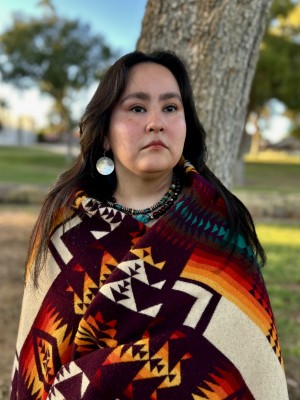
I Am a Line of Words: An Interview with Mirra Keeto
Keeto was interviewed about her exhibit. She was interviewed by Marilyn Murphy, Communications Specialist/ You can read the article, "ASU grad showcases family, cultures in library art exhibit" here.
The interview below was generated to dive deeper into the artist behind the art and celebrate what gifts flourish from libraries that provide safe spaces for Indigenous students.
The interview is structured as a series of questions that were given to the artist followed by her answers to each question. Some words have been altered or inserted by the interviewer for clarification or context and are within brackets.
Tell me about yourself: where are you from? How did you come to ASU and what did you major in? What do you want people to know about you?
Both my mom and dad's family come from the Gila River and Navajo Nation. My clan is Towering House Clan. My dad's family is from Fort Defiance and on my mom’s side, Sheep Springs, New Mexico. We’re a part of the Gila River tribal community. I was born in Phoenix, but was brought up on/off the reservation. My mom lives near Coolidge. My dad lived in Phoenix all of his life and my mom used to joke he was an “urban indian”.
I transferred to Arizona State University (ASU) three years ago. Before that I was at Chandler Gilbert Community College (CGCC). I was unsure what I wanted to do. [During my time at CGCC] I had an empty spot in my schedule –so I chose to take Art History 101. It was Renaissance through contemporary art, so I took it just for fun. I enjoyed it so much that at the end of the semester, I told my professor, Dr. Rosa Najafi, I want to be an art historian. I took a gap year, but once I completed my credits I transferred to ASU in fall 2022. From there, I continued on the art history path, and [my advisor] informed me that there was a language requirement for the bachelors in which I needed to pick a language. I chose Italian because I thought it would be an interesting experience. Although, I didn't know anyone who spoke Italian at the time. I became more involved in the American Indian community at ASU, and for the most part I went to Discovery Hall. Sometimes I attended talking circles. It was important [for me] to remain connected with my heritage and culture. My mom is an alumni, so she encouraged me to go to ASU. My brother and sister also [attended] ASU.
I don't consider myself a professional artist. For me, my artwork is very personal. When I feel like it, I will draw or paint. I don't really show my artwork. If I get to know someone on a deep level, I will make them artwork. Art is a way for me to express my appreciation. I've given artwork to my friends, professors. This experience has been very rewarding for me. I'm very proud of where I come from. Most importantly, I feel a need to carry on this legacy that my father left behind when he passed, as well as for my other family members who have passed on. It is my responsibility to do good, do good in their name, because they mean a lot to me. I do what I do to honor them. My mom, as well. I also really love a lot of music, play video games when I have time, [and] go to concerts with my siblings. If you really want to know who I am, look at my artwork. I always leave a trace of me behind."
What initiated your interest in Italian art and the Italian language?
"A decade ago, [a video game called] Assassin's Creed 2 came out. I watched my brother play the game when I was young. I originally was intrigued because [as a player] you could ride on the horses. When my stepmom's cousin moved in at my dad's house, he had ps3 games and offered them to us to play with. AC 2 was one of them. I got immersed in the game. The story showcased Renaissance art by Leonardo da Vinci, Michelangelo, Raffaelo, Fra Angelico, and more. As you progressed through the videogame, you could see what Leonardo was working on, his sketches and concepts. The artworks purchased by Ezio Auditore, end up in the Auditore Villa, located on the outskirts of Florence. Leonardo’s earliest works such as the Annunciation, Portrait of a Musician, The Baptism of Christ - his first Andrea del Verrocchio, could be collected. These paintings were before the Mona Lisa."
In the fall semester [of 2023], I needed [to take] some art history courses to complete the major. I enrolled into the Italian Renaissance Art course online, and it was the most rewarding class I've taken. Professor Dr. Renzo Baldasso and his course opened my eyes. He spoke about manuscripts and early printing in Italy, which I had not previously considered to classify as Renaissance Art . When I watched the lectures, I took heavily detailed notes. Three weeks into the semester I wanted to know how to connect with him more on Renaissance art. I assumed he was Italian, and I wrote my email [to him] in Italian. For the last two years, we've kept in contact. He's been a really great mentor
Dr. Enrico Minardi has also been a great mentor. I took his course, Italian Renaissance Culture last year in the fall. Dr. Minardi’s expertise in historical Italian literature along with Dr. Baldasso’s philosophy on the visual history of the arts in Italy, immensely complimented one another. They are interconnected. We talked a lot about humanism. We went into depth about poetry, and I was reintroduced to Dante Alighieri. Dr. Minardi encouraged me to do two art history presentations for Gothic to Pre-Renaissance, and the Renaissance, entirely in Italian – which was very difficult, but proved to be a great experience!
I cannot fully express my gratitude to them both. In my masters’ I plan on combining both of my professors' perspectives. I still cannot believe that I know them both!
What brought you to create this exhibit?
This exhibition started with the friendship I have with Dr. Enrico Minardi. What started as a simple individual research study, metamorphosed into this exhibit. I’ve often heard it said that this exhibition is a reflection of the connection we have. I feel that this is where it began.
It is also the result of all of the aspects I’ve learned about Italian culture at ASU. Every culture has it’s good and terrible moments in their histories. One course I took, "Italian Culture: the Good, Bad, and the Ugly”, is a vital example of this contrast. It was radical for me, because [it] touched on controversial aspects, like facism in Italy, how refugees were/are treated, colonialism around Italy. Not the usual and often glamourized image people see when they think of Italy.
One of my art pieces, L'oscurità, takes inspiration from an Italian photographer, Gabrielle Basillico. All of his pictures are black and white. They're mostly of urban Italy, or various street scenes and perspectives of that nature. So with the three pictures that I chose [in L'oscurità], I picked the colosseum, and this sort of street corner and women covered in dark robes. I originally wanted it to be like a triptych, which is like an altar piece with two small sides to it and a center piece. That's how I had it originally constructed. [The images] were organized in a way to provide a narrative…so, for me, I sort of imagined these people walking to their destination. They come by the street corner and the colosseum is right there. I think [this piece] sort of deglamorizes the stereotypical image of Italy (la dolce vita). [L'oscurità] says it's not all sweet.
For L'oscurità, I was wondering how to fill in the space. And like I said, I'm always surrounded by music whenever I draw, so for that piece in particular, I thought, yeah there's a lot of darkness. It's black. I thought of three songs that all have the word black in their title. So at the very top, [the song title "Wait for the Blackout" is from] a group called The Damned. I love that song. It's not as dark musically (not goth) but it's kind of punky. From that song, I chose the lyric, "At first you may find it strange: the darkness holds a power that you won’t find in the day”. The second one I chose was written by The Sisters of Mercy. Right when I did the drawing, I instantly thought of their song, "Black Planet." Close to the second drawing I put "So dark, so dark, all over Europe." To me it illustrates the overall feeling of this piece. I sort of leave the piece on an optimistic note with the last few lines on the bottom left. "Black Celebration”, by my favorite group Depeche Mode. I placed it near the people walking because I thought you know, despite all the darkness there is in the world there is some sort of glimmer of hope…that things can get a lot better. And for me it really resonated because I've had so much loss with my family members over the years and I sort of carry that weight of the grief of not having them physically here anymore. “Your optimistic eyes seem like paradise to somebody like me.”
It’s definitely one of my favorites featured in the exhibition. Dr. Minardi recommended this photographer and subject.
Italy and Indigenous peoples have a complicated history. In what ways do you talk about colonialism within your art and the conversation between the two?
In Dr. Juillian Vitullo’s course, we learned about Italian colonialism in Ethiopia. We read an author named Gabriella Ghermandi, who is Etho-Italian. She writes about how being biracial affected her way of life. She grew up in an Italian way and her own sort of Indigenous way. She talked about her struggles in living both identities. I think in that sense, with our own [experience with] colonialism, even now Native people [navigate being] Urban and non-urban Natives, it reminded me of An Absolutely True Story of a Part-Time Indian [by Sherman Alexie], where you're either "too educated" or "not educated enough" and it sort of translated into Gabriella's work. They had similarities, like discrimination. The difference, I believe, is that Italy did not have boarding schools.
What is the significance behind your title, “I Am a Line of Words”?
I took inspiration from John Trudell, he was a Santee Dakota activist and musician. Years ago, I studied an [American Indian Studies] course before I transferred to ASU and learned about the American Indian Movement. I grew an admiration for [Trudell] and enjoyed reading his poetry and listening to his music, hearing his philosophy on the human spirit. I admire what he did for Indigenous communities. One day in Labriola, I was looking at his book, Lines from a Mined Mind. I modified [the exhibition's title] from that title. [Lines from a Mined Mind brings together lyrics and musings from the twenty-five-year recording career of John Trudell, an internationally acclaimed poet, musician, and leader of the American Indian Movement. More than a simple anthology, this collection goes deeper, revealing the incendiary intersection of music and activism.] Music has been a way to express my feelings. The lyrics speak to who I am. I better understand myself through music, I listen to a lot of different things. I speak through music.
What are you most looking forward to for the grand opening of your art exhibit?
I'm looking forward to bringing my family, my friends, and my former professors all together to see the exhibit. They all mean the world to me, and I can never thank them enough for their guidance and support! It's a collaboration between very different cultures, a place they find a common ground. In the end, I'm not doing this for me. I'm doing this for everyone that I love and admire. There's not a lot of exposure for non-Indigenous people to really know about our history and culture, and most certainly, our art. I hope I can make everyone proud. I hope people can realize and see that despite having homelands in opposite ends of the world, two cultures can come together in unison.
I don't know what I want in terms of the outcome, honestly!
Why did you want your art to be shown in the Labriola Center?
I found out about Labriola from one of my professors. So…throughout my time, I'd come by here to study and do homework. It was nice to also talk with other Indigenous students and relax after class! Labriola has always been a welcoming space and having this exhibition here is something that I am very proud of. In some way it's a form of gratitude, for me to connect and give back and a way to show thanks for me being welcomed so warmly.
Interview conducted by Yitazba Largo-Anderson.